Mesopic
A lighting house's IES and EULUMDAT files rendered in the browser, where the visitor moves the fixture and every lux figure is integrated from the file.
About Mesopic
What it is
Mesopic is a website for a lighting house: a manufacturer, an LED brand, a film and stage rental house. Every lighting company publishes an .ies or .ldt file for each product, and publishes it as a download, so a specifier has to open DIALux or Relux to find out what the light does.
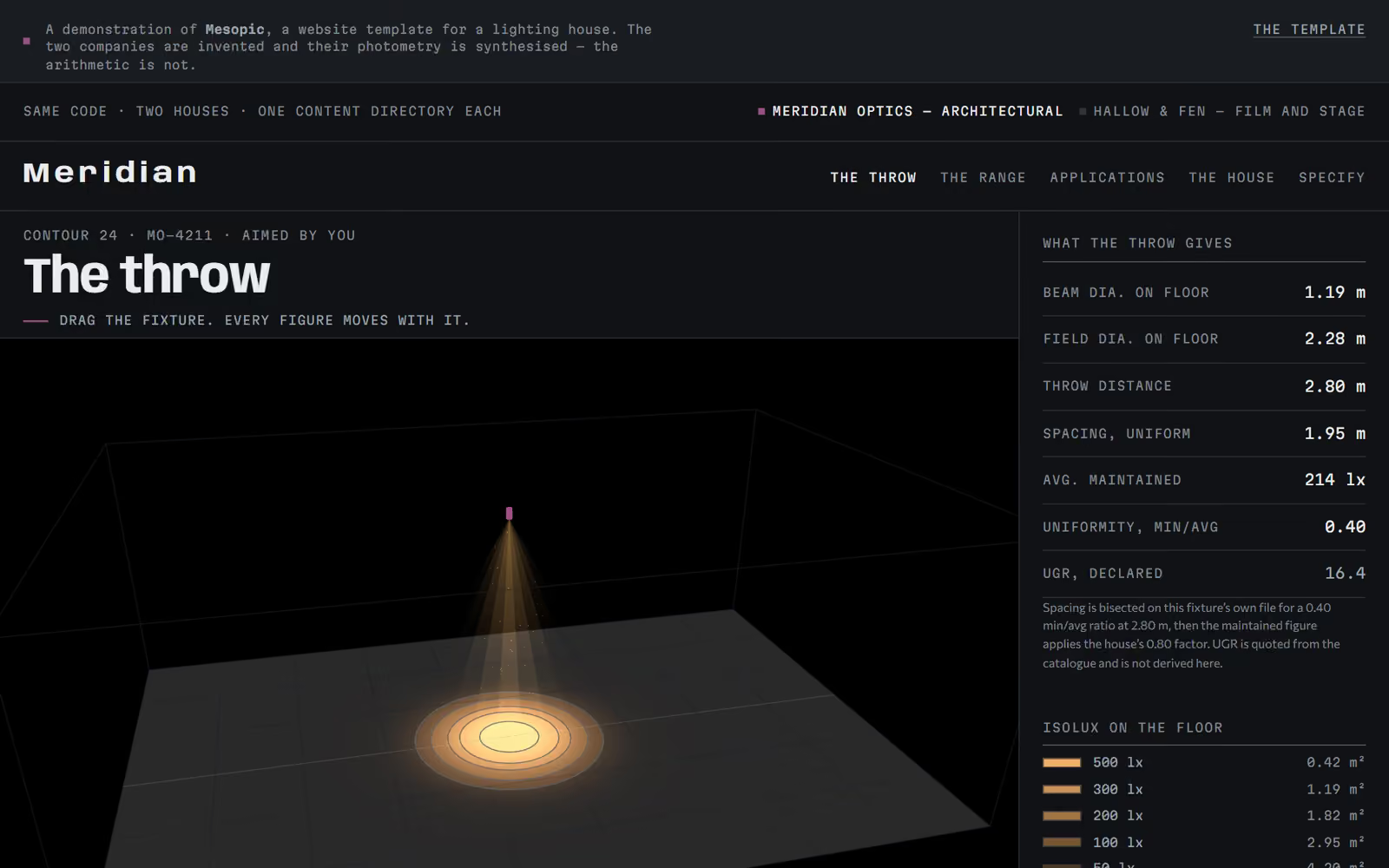
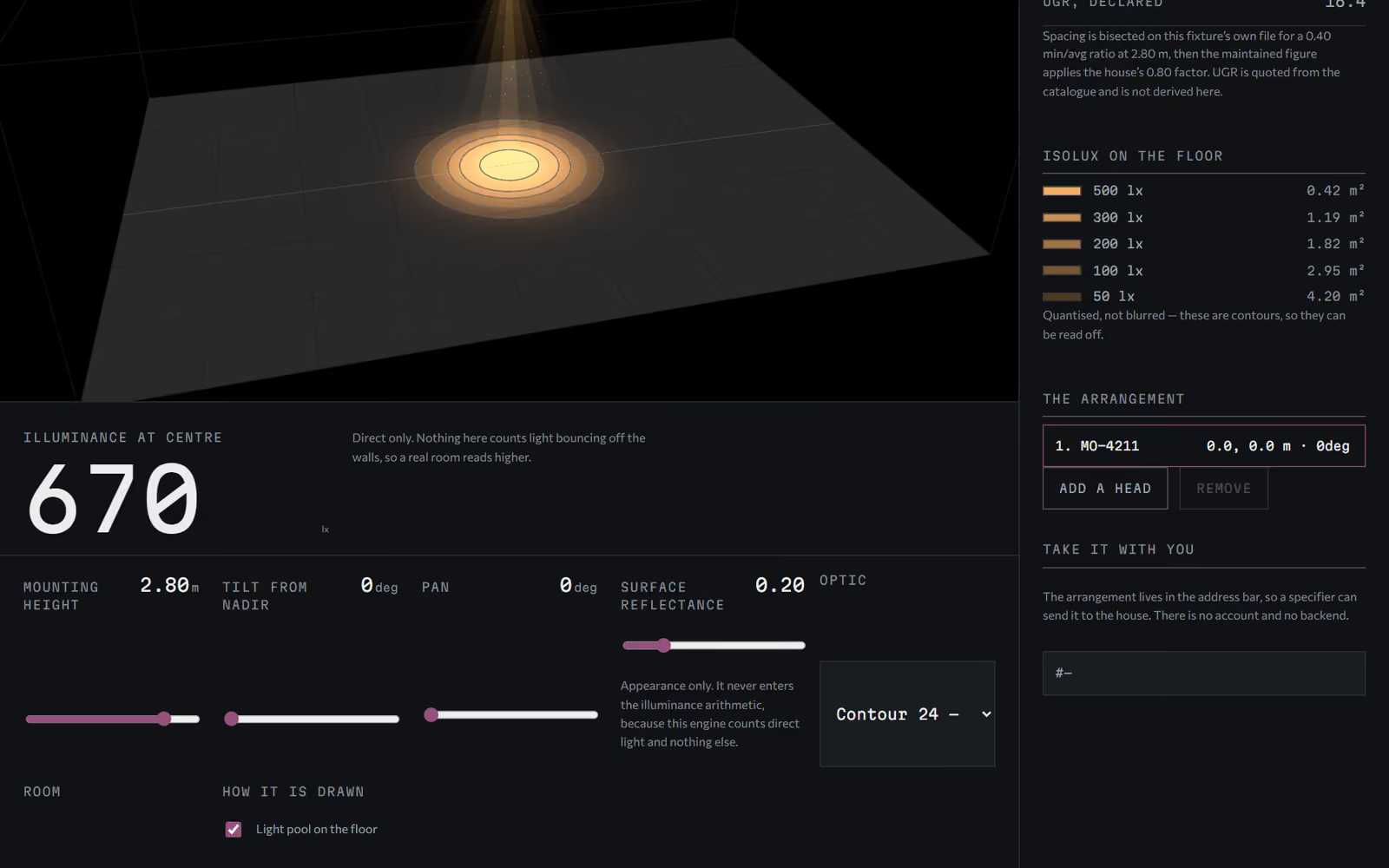
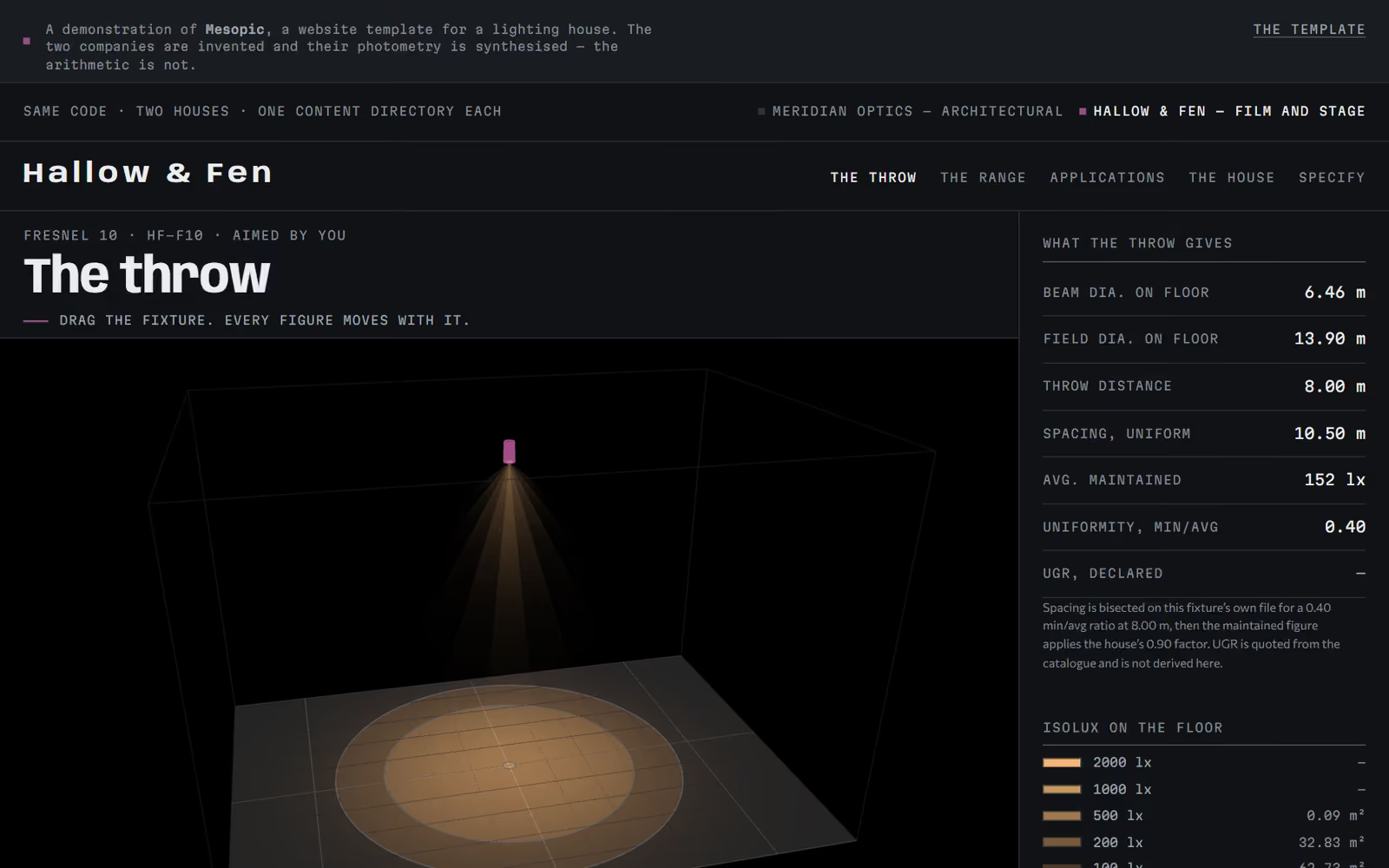
Mesopic renders the file on the page. A dark room, one luminaire, its beam on the floor, isolux contours as bands, the illuminance at centre in lux, and the visitor moves the fixture. Lower it from 2.80 m to 1.60 m and the centre goes from 670 lx to 2,050 lx. None of those figures is typed. Illuminance, flux and beam angles all come from the file's own candela grid.
What you change
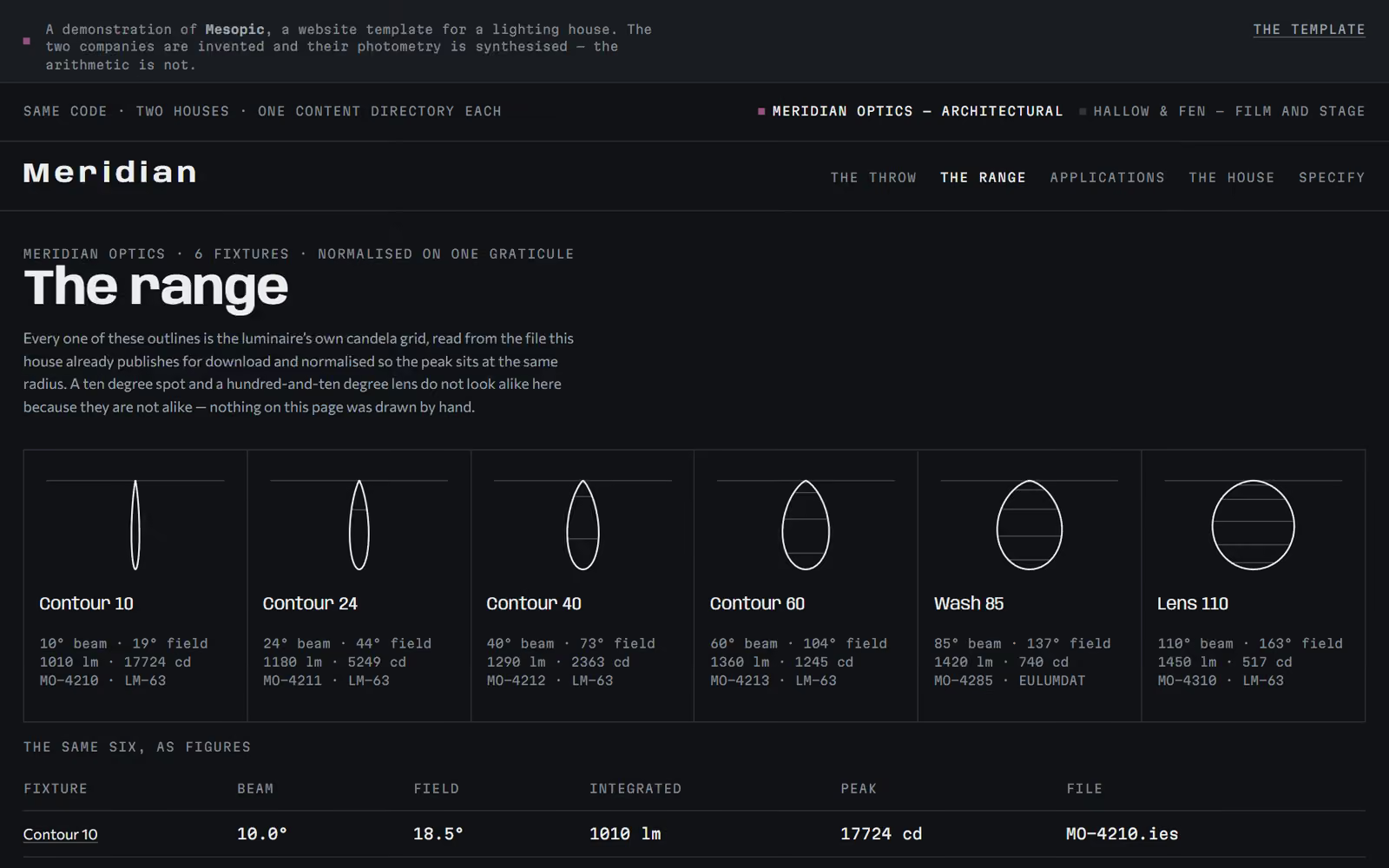
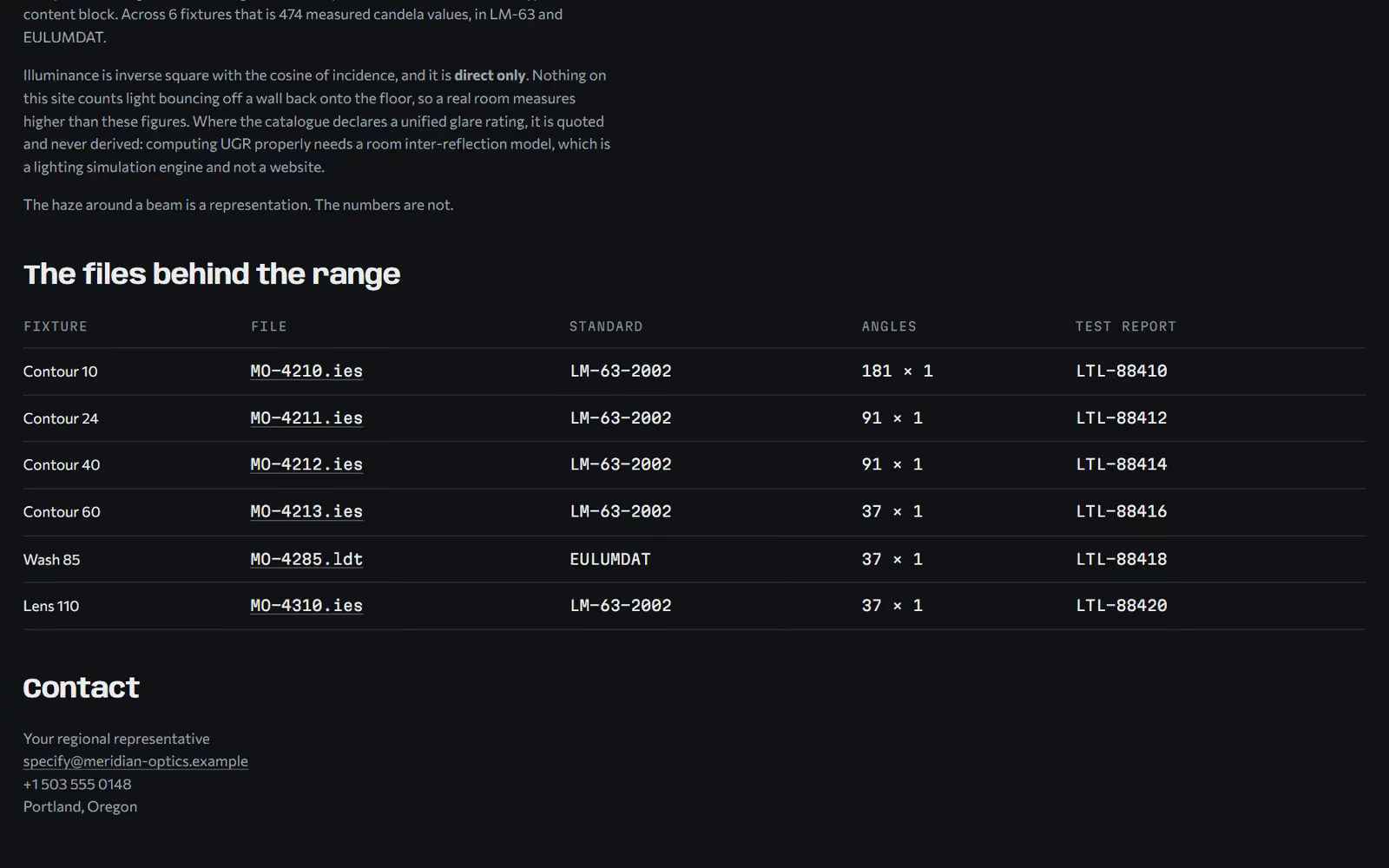
The photometric files. Replace the twelve in the demo with your client's own, and the range, the bodies of light, the beam diameters and every lux figure change with them.
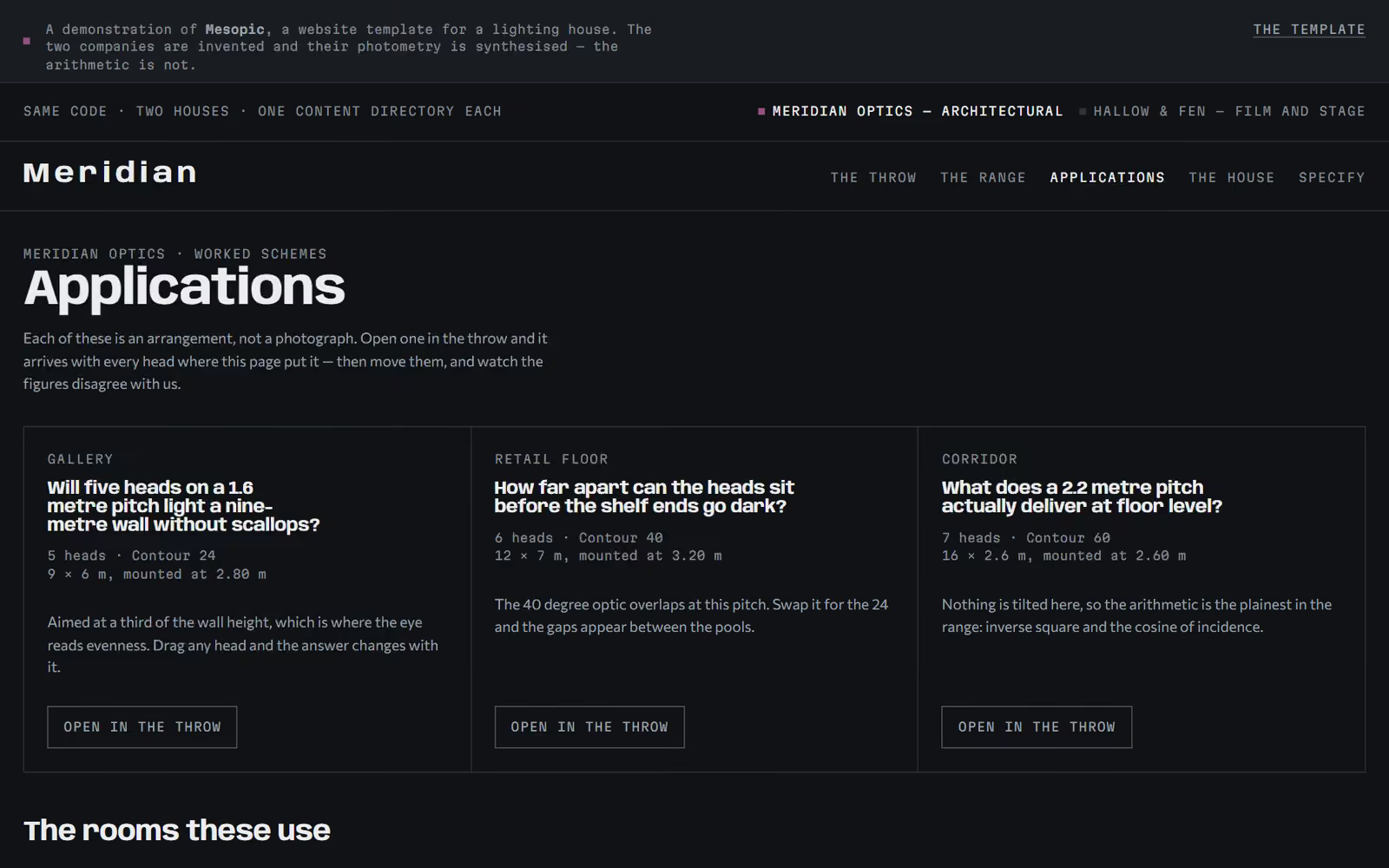
Each house is one content directory, and no code branches on which house is rendering. The demo has two: an architectural range under a 2.8 m ceiling and a stage rental house at an 8 m trim. Delete one directory and the house switch at the top disappears by itself.
What is measured
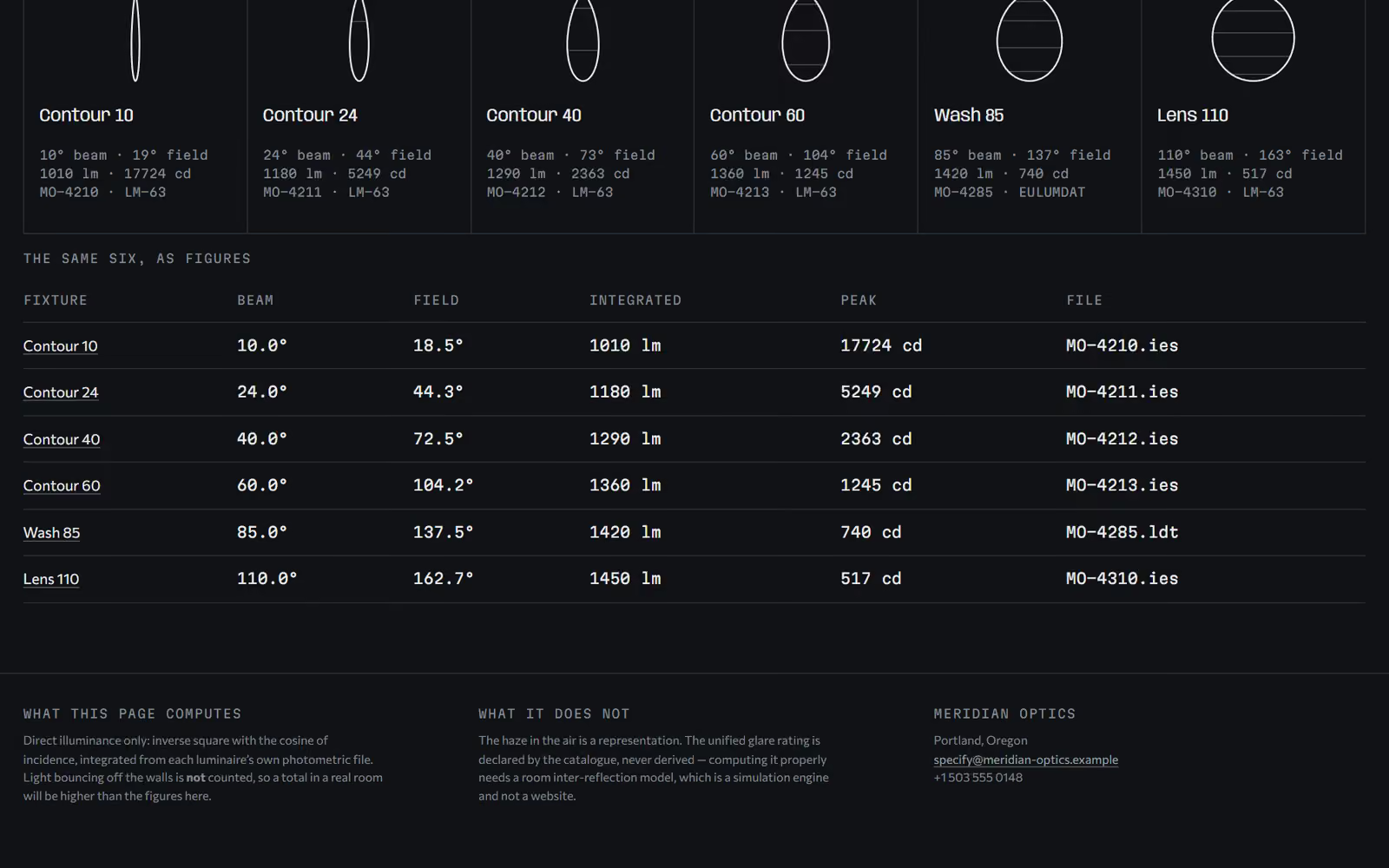
169 unit tests, and six more that run once you add a manufacturer's own files. A build check integrates every fixture's candela grid over solid angle and compares it with the lumens the file declares. Beyond 3% the build stops and names both figures.
A browser gate makes 132 route checks on real device profiles, and each of its seventeen assertions was shown failing before it was trusted.
What it does not do
It draws direct light only. Nothing counts light bouncing off a wall, so a real room measures higher, and the page says so wherever it prints a figure. It reads Type C photometry only, and refuses Type A and Type B by name at build time.
There is no cart, no CMS and no account system, because lighting sold by specification has never wanted one. The twelve demonstration files are synthesised from optical models, and the two companies do not exist.
From the demo
Specification
- Framework
- Next.js 16 (App Router) · React 19 · TypeScript 5
- Styling
- CSS Modules over one tokens file of eight measured colours. No Tailwind
- Output
- Static export. No backend, no cart, no accounts
- Pages
- Eleven per house: the throw, the range, six fixtures, applications, the house, specify
- Requires
- Node 22 or later · pnpm 11
- Tested
- 169 unit tests; a flux reconciliation at build; a browser gate of 132 route checks
- Lighthouse
- Mobile: performance 83 on the first screen, 92 on a fixture, 99 on the two routes with no canvas; the other three scores 100 on all four
- Typefaces
- Anybody, Commissioner, Martian Mono (SIL OFL 1.1, self-hosted by next/font at build)
- Demo photography
- None. The twelve demonstration photometric files are synthesised from optical models, and say so
- Not included
- A cart, accounts, a CMS, a backend. Type A and Type B photometry, refused by name at build
Only in Mesopic
- Photometry
- LM-63 and EULUMDAT parsed at build, flux held to the declared lumens within 3%
- Light
- Direct light only: inverse square, cosine of incidence, isolux as quantised bands
Changelog
- v1.1.18 Oct 2026Next.js at its September 2026 security release (16.3.8). Pages unchanged; the ZIP's paths now use forward slashes.
- v1.1.03 Sep 2026The beam is computed from the file, the canvas can no longer fail in silence, and aiming has one definition.
Licence
Standard
$179
One end product — one website, for you or for one client. Modify it freely. You may not resell or redistribute the source, and you may not use it to build a competing template.
Extended
$399
Unlimited end products for one buyer. For a studio that serves several lighting clients: same source, wider licence, bought once.